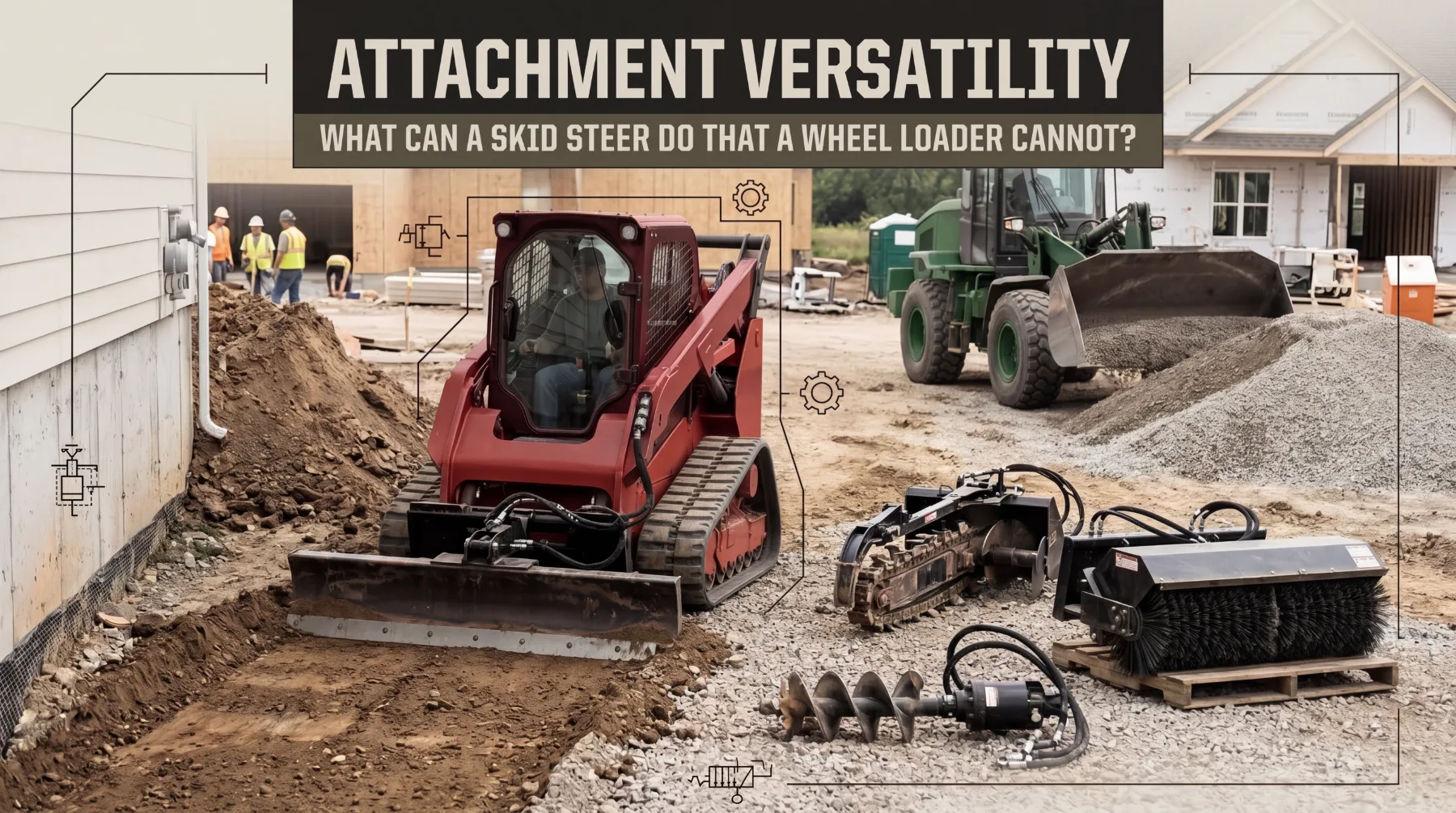
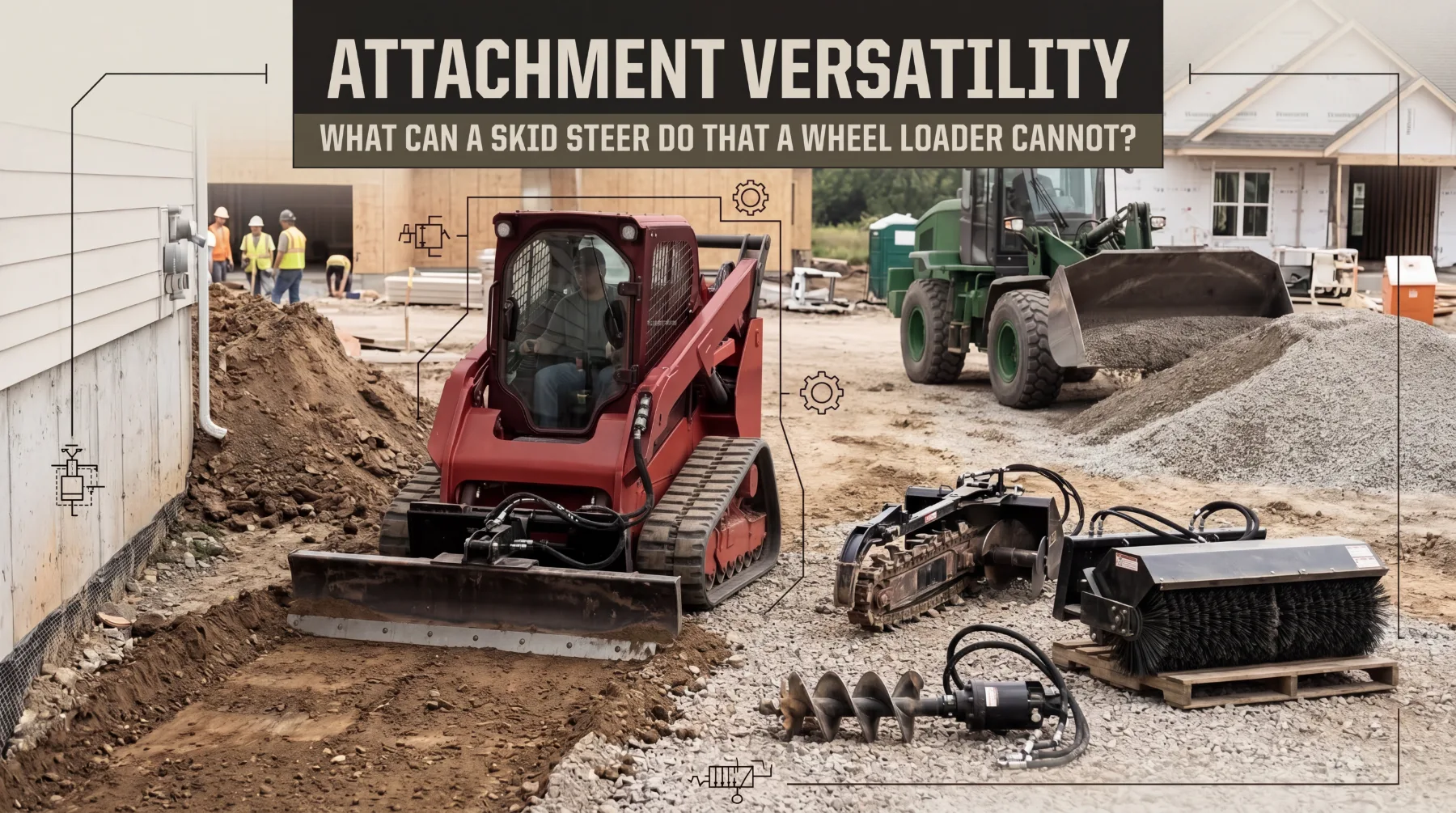
A wheel loader is one of the most productive machines on a jobsite when the task is moving material. It scoops, carries, and loads trucks efficiently, and larger models handle volumes that smaller machines cannot match. A skid steer earns its place in a different way. Its real strength is the ability to change roles quickly by switching attachments, turning one compact carrier into a trencher, a sweeper, a grader, an auger, or a landscaping tool within minutes. For contractors, landscapers, and property managers, that flexibility often determines which machine delivers more value across a full season of work.
This guide explains what a skid steer can do that a wheel loader typically cannot, across five practical areas. You will learn how skid steers handle far more than bucket work, how trenching and excavation attachments expand their role, how sweeping, grading, and site preparation tools add value, why compact access matters for attachment work, and how to match hydraulic power to the attachments you plan to run. The goal is a clear, practical understanding that helps you choose the right equipment for the jobs you actually do.
Handling More Than Bucket Work
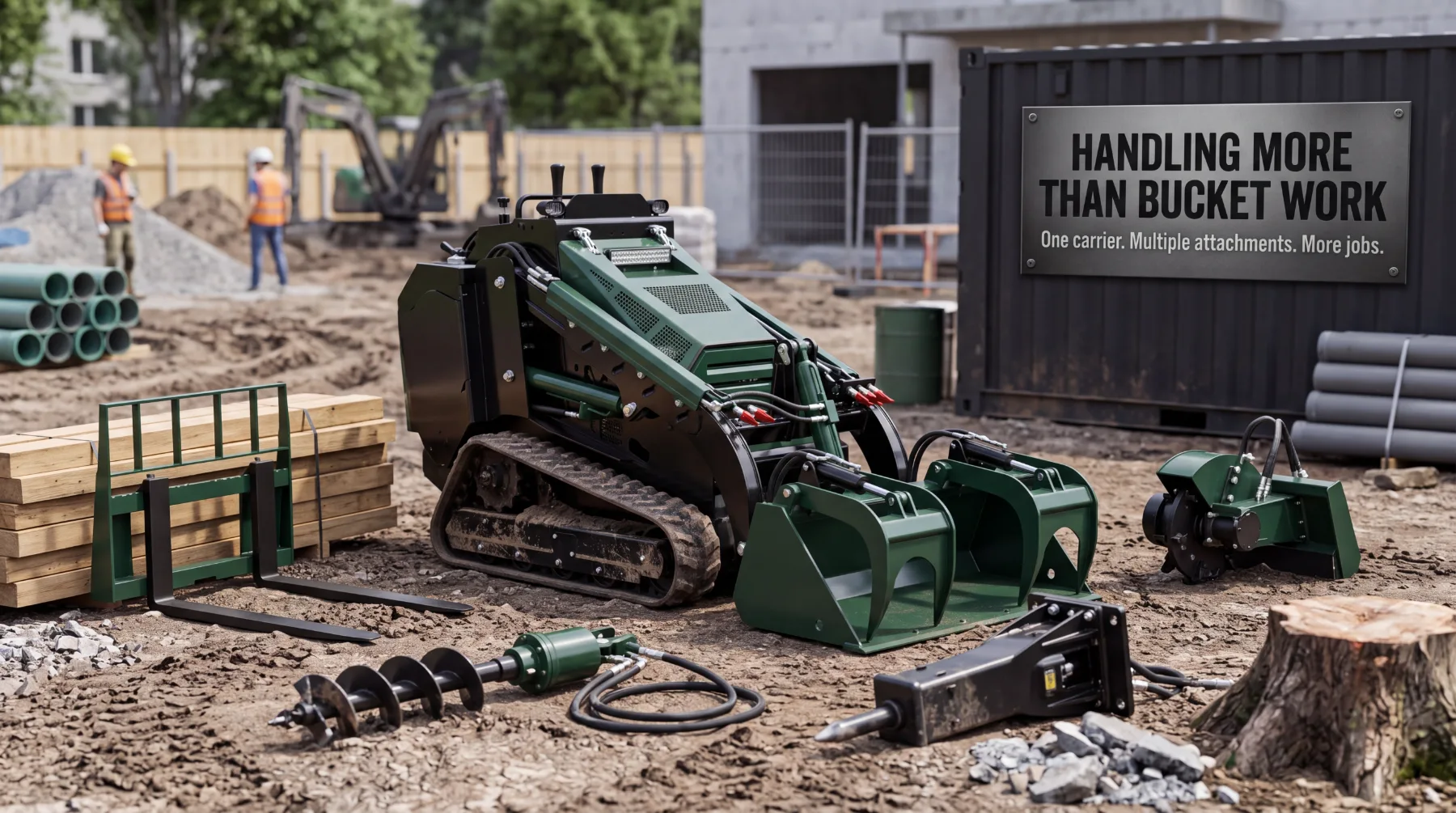
A skid steer can operate a wide range of hydraulic and powered attachments beyond standard bucket tasks, and this versatility is the foundation of its value. Most wheel loaders are built primarily around the loading function. They excel at digging into stockpiles, carrying material, and filling trucks, and while many can use forks, grapples, or other tools, their design is centered on high-volume material handling. A skid steer, by contrast, is designed from the start as a multi-purpose carrier. Its quick-attach plate and auxiliary hydraulic system allow it to connect to dozens of different tools, each of which transforms what the machine can accomplish.
This allows one machine to take on different jobs without relying solely on its loading function. The range of available attachments is extensive, and common examples include:
- Pallet forks for moving palletized materials, pipe, and building supplies
- Augers for drilling post holes, footings, and tree planting holes
- Grapples for handling brush, logs, scrap, and demolition debris
- Hydraulic breakers for breaking concrete, asphalt, and rock
- Snow blowers and snow pushers for winter property maintenance
- Stump grinders and mulchers for land clearing and vegetation management
Each of these tools gives the skid steer a new capability, and many of them are powered attachments that rely on the machine’s hydraulics rather than simple mechanical force.
The practical benefit is significant. Instead of purchasing, transporting, and maintaining several specialized machines, a business can invest in one skid steer and a selection of attachments suited to its work. A landscaping crew might drill holes in the morning, move pallets of pavers at midday, and clear debris in the afternoon, all with the same carrier. That kind of flexibility keeps the machine busy across more tasks, improves equipment utilization, and helps owners get a stronger return from every hour the machine runs.
Trenching and Excavation Attachments
With the appropriate attachment, a skid steer can perform tasks such as trenching, digging, and soil preparation that a wheel loader is not designed to handle. A wheel loader’s bucket is built for scooping and carrying loose or stockpiled material. It can dig into a pile or strip topsoil, but it cannot cut a narrow trench for utility lines or drill a precise hole for a fence post. A skid steer equipped with the right tool can do both, which makes it valuable on projects where digging work would otherwise require a separate machine.
Specialized tools can make the skid steer suitable for work that would otherwise require dedicated equipment. A chain trencher attachment cuts clean, narrow trenches for irrigation lines, electrical conduit, drainage pipe, and communication cables, removing soil efficiently with minimal disturbance to the surrounding area. A backhoe attachment lets the skid steer dig footings, small foundations, and utility trenches with a digging motion similar to a compact excavator. Auger attachments bore vertical holes for posts, piers, signs, and plantings, and interchangeable bits allow operators to match hole diameter to the task.
Soil preparation is another area where attachments extend the machine’s role well beyond loading. A tiller breaks up compacted ground and blends amendments into the soil for planting beds and lawns. A soil conditioner, sometimes called a power rake, loosens the surface, removes rocks and debris, and prepares a smooth seedbed for sod or seed. These tools help landscapers and contractors finish work quickly and consistently.
For many businesses, this capability reduces the need to rent or own a trencher, a compact excavator, and a tiller for smaller jobs. That does not mean a skid steer replaces a full-size excavator on heavy digging projects. It means that for light and medium excavation, trenching, and soil work, a properly equipped skid steer can handle the job efficiently while remaining available for all of its other tasks.
Sweeping, Grading, and Site Preparation
Attachments such as sweepers, graders, and landscape tools expand a skid steer’s role in construction and property maintenance. Surface preparation and cleanup are constant needs on jobsites, commercial properties, parking areas, and farms, and they are tasks a wheel loader is rarely suited to perform with precision. A skid steer, fitted with the right tool, can move from rough site work to finished surface preparation without changing machines.
Sweeper attachments are among the most widely used. Angle brooms push dirt, gravel, snow, and debris to one side, while pickup sweepers collect material into an enclosed hopper for easy disposal. Contractors use them to keep roads clean around construction entrances, prepare surfaces before paving, and clear parking lots after projects. Property managers rely on them for routine maintenance of driveways, warehouse yards, and walkways.
Grading tools help the skid steer create smooth, level surfaces. Grader blades and box blades spread and level gravel, soil, and base material, making them useful for driveways, building pads, and walkway preparation. Laser-guided grading attachments, where used, can help operators achieve accurate grades for slabs and flatwork. Landscape rakes smooth soil, gathers rocks and roots, and leaves a clean finish ready for planting or sod.
These tools allow the machine to perform several surface-preparation tasks using the same carrier. On a typical project, the skid steer might clear debris, spread and level base material, prepare soil for landscaping, and sweep the finished area before the crew leaves. Handling each step with one machine reduces transport and setup time, keeps crews moving from task to task without waiting for different equipment, and helps deliver a consistent, professional finish. For businesses that handle both construction and ongoing property maintenance, this range of capability is one of the strongest reasons to choose a skid steer.
Compact Access for Attachment Work
Skid steers are designed for maneuverability in relatively tight work areas, making them useful where larger loaders may have limited access. Their compact frame and skid steering system allow the machine to turn within its own footprint, pivoting in place rather than requiring a wide turning radius. A wheel loader, even a compact model, typically steers through an articulated frame and needs more room to maneuver. On open sites that difference may not matter, but in confined spaces it often decides which machine can do the job at all.
Their compact dimensions can make attachment-based work easier around buildings, landscaping projects, and confined jobsites. Consider the settings where skid steers regularly outperform larger machines:
- Residential yards and landscaping projects, where gates, fences, trees, and existing structures limit access
- Building perimeters and foundations, where work must happen close to walls and footings
- Interior and demolition work, where smaller machines can enter buildings through large doorways
- Urban lots and tight commercial sites, where space is shared with materials, vehicles, and other trades
- Barns, livestock facilities, and warehouses, where aisles and stalls restrict movement
In each of these environments, attachment work such as trenching, grading, sweeping, or auger drilling can be carried out right where it is needed.
Compact access also brings practical advantages beyond maneuvering. Skid steers are generally easier to transport on a standard trailer, which reduces hauling costs and allows crews to move between jobs quickly. Track-equipped models, known as compact track loaders, spread their weight over a larger area, which can reduce ground disturbance on lawns and finished landscapes and improve traction on soft or muddy ground. When a job combines tight quarters with a need for multiple attachments, the skid steer’s size and agility let operators complete the work efficiently, safely, and with less disruption to the surrounding property.
Matching Hydraulic Power to Attachments
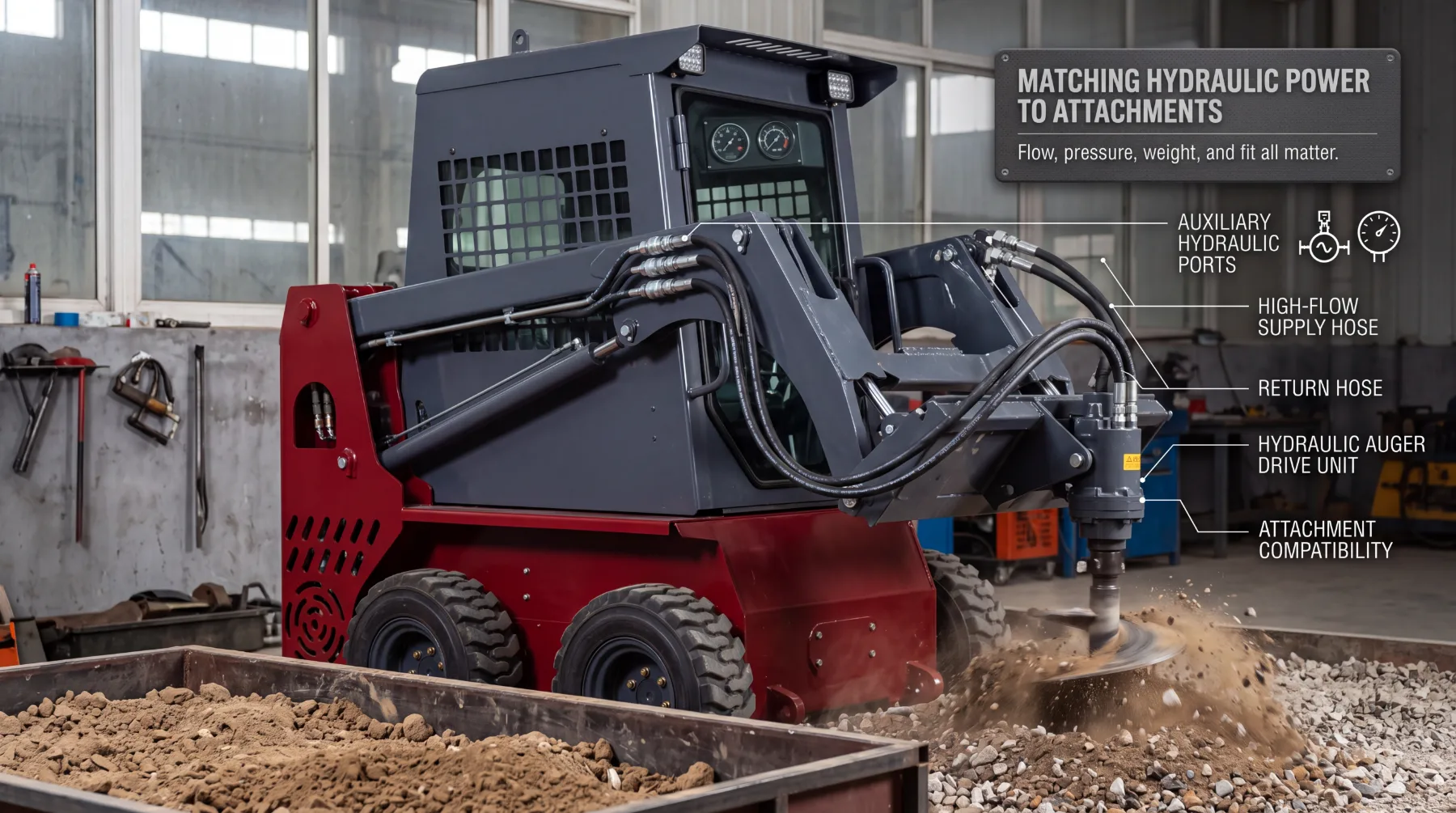
Many powered attachments depend on the skid steer’s auxiliary hydraulic system for operation, so matching the carrier to the tool is essential for performance and safety. The auxiliary circuit supplies pressurized hydraulic fluid through couplers at the front of the machine, driving the motors and cylinders inside attachments such as augers, trenchers, sweepers, breakers, and mulchers. If the carrier cannot supply what the attachment requires, the tool will underperform, overheat, or fail to operate at all.
Hydraulic flow, pressure, attachment weight, and mounting compatibility should be checked to ensure the carrier can properly operate the selected tool. Flow, measured in gallons per minute (gpm), determines how fast the attachment’s motor turns. Standard-flow skid steers commonly deliver roughly 17 to 25 gpm, which suits augers, grapples, brooms, and many trenchers. High-flow systems often provide around 30 to 45 gpm, and they are needed for demanding tools such as forestry mulchers, cold planers, and large stump grinders. Pressure, measured in psi, determines how much force the attachment can generate, and most skid steer auxiliary systems operate in a range near 3,000 to 3,500 psi. Always compare the attachment’s requirements to the machine’s published specifications.
Weight and mounting matter just as much. A heavy attachment reduces the load the machine can safely carry and affects its balance, so the combined weight of the tool and any material it handles should stay within the skid steer’s rated operating capacity. Most modern skid steers use a universal quick-attach plate, which allows a wide range of tools to connect easily, but it is still important to confirm that the mounting system, hydraulic couplers, and any electrical connections for attachment controls are compatible.
Taking time to match the carrier and attachment protects your investment. A correctly matched combination runs efficiently, delivers the performance the tool was designed to provide, and reduces wear on both the attachment and the machine’s hydraulic system.
Conclusion
A skid steer’s greatest advantage over a wheel loader is its attachment versatility. While a wheel loader remains the stronger choice for high-volume loading and material handling, a skid steer can move far beyond bucket work. With the right tools, it can trench, dig, drill, and prepare soil, sweep and grade surfaces, and handle a wide range of site preparation and property maintenance tasks. Its compact size and tight turning ability let it perform that attachment work around buildings, in landscaped yards, and on confined jobsites where larger machines struggle to reach.
Getting the most from that versatility depends on a proper match between carrier and tool. Before adding attachments to your fleet, review the hydraulic flow, pressure, attachment weight, rated operating capacity, and mounting compatibility of your skid steer, and choose tools that suit both the machine and the work you do most often. When the carrier and attachments are matched correctly, one skid steer can deliver the output of several specialized machines, keeping your crews productive and your equipment working across every season. Contact our team to discuss which skid steer and attachment combination best fits your projects.
Frequently Asked Questions
1. What makes a skid steer more versatile than a wheel loader?
A skid steer is designed from the start as a multi-purpose carrier, while most wheel loaders are built primarily around loading and material handling. The skid steer’s quick-attach plate and auxiliary hydraulic system allow it to connect to a wide range of tools, including augers, trenchers, sweepers, grapples, breakers, tillers, grader blades, and snow equipment. Many of these are powered attachments that use the machine’s hydraulics to run motors and cylinders, giving the skid steer capabilities that go well beyond scooping and carrying. Its compact size and ability to turn within its own footprint also let it perform this attachment work in confined spaces where a wheel loader may not fit. Wheel loaders can use some attachments, such as forks and grapples, but their design favors high-volume loading. For businesses that handle a variety of tasks, the skid steer’s ability to switch roles quickly makes it one of the most flexible machines available.
2. Can a skid steer replace an excavator for digging work?
A skid steer can handle many light and medium digging tasks when equipped with the right attachment, but it does not fully replace a dedicated excavator for heavy or deep excavation. With a backhoe attachment, a skid steer can dig footings, small foundations, and utility trenches. A chain trencher cuts narrow trenches for irrigation, conduit, and drainage lines, while an auger bores holes for posts, piers, and plantings. For residential projects, landscaping, and smaller commercial jobs, these tools can eliminate the need to rent or transport a separate machine. However, a full-size excavator offers greater digging depth, reach, breakout force, and production for large-scale earthmoving, deep trenches, and heavy material. The best approach is to match the equipment to the scale of the job. For frequent smaller digging tasks combined with other work, a properly equipped skid steer is often the more efficient and cost-effective choice.
3. What is the difference between standard-flow and high-flow skid steers?
The difference lies in how much hydraulic fluid the auxiliary system delivers to the attachment, measured in gallons per minute. Standard-flow skid steers commonly supply roughly 17 to 25 gpm, which is enough to run many popular attachments, including augers, grapples, angle brooms, pallet forks with hydraulic functions, and many trenchers. High-flow systems typically deliver around 30 to 45 gpm, providing the additional hydraulic power needed for demanding tools such as forestry mulchers, cold planers, large stump grinders, and some snow blowers. Running a high-flow attachment on a standard-flow machine usually results in poor performance, slow operation, or no operation at all. When choosing a skid steer, consider the attachments you plan to use now and in the future. If demanding powered tools are part of your work, a high-flow machine provides the capacity those attachments require and expands the range of jobs the carrier can take on.
4. Why are skid steers better suited to tight jobsites?
Skid steers are built with a compact frame and a skid steering system that allows the machine to pivot within its own footprint. This lets operators turn, reposition, and work close to obstacles in spaces where a wheel loader, which typically steers through an articulated frame, would need much more room. As a result, skid steers perform well in residential backyards, along building foundations, inside barns and warehouses, on urban lots, and on landscaping projects surrounded by fences, trees, and structures. Their smaller size also makes them easier to transport on a standard trailer, which helps crews move between jobs efficiently. Compact track loaders, the tracked version of the skid steer, add the benefit of lower ground pressure, which can reduce damage to lawns and finished surfaces while improving traction on soft ground. When confined access and multiple attachment tasks come together on one job, the skid steer’s agility makes it a practical and productive solution.
5. How do I know if an attachment is compatible with my skid steer?
Start by comparing the attachment’s requirements with your skid steer’s published specifications. Check the hydraulic flow, measured in gallons per minute, to confirm your machine delivers what the attachment needs, and verify that the operating pressure falls within your auxiliary system’s range. Next, review the attachment’s weight. The combined weight of the tool and any material it carries should stay within the machine’s rated operating capacity to maintain safe, stable operation. Mounting compatibility is also important. Most modern skid steers use a universal quick-attach plate, but you should confirm that the attachment fits properly and that the hydraulic couplers match. Some attachments also require an electrical connection to operate their controls from the cab, so confirm that your machine supports it. When in doubt, consult the equipment dealer or manufacturer. A properly matched attachment runs efficiently, performs as designed, and protects both the tool and your skid steer’s hydraulic system from unnecessary wear.